

A buyer in Montreal can spend a Saturday morning comparing a Plateau triplex, a Griffintown condo, and a West Island house, then end the day wondering why the headlines still sound contradictory. The answer is usually not that the market is confusing. The answer is that a Montreal real estate market analysis has to separate property type, neighbourhood, inventory, and timing before it tells the truth that matters to a buyer or seller.
For someone preparing to move, list, or relocate, that distinction changes everything. A downtown condo, a family bungalow in the West Island, and a plex in the Plateau do not respond to the same pressure, even when they sit inside the same metro area. The numbers below point to a market that has moved from a sharp seller's phase into a more balanced, segmented one, where the practical question is less “Is Montreal hot?” and more “Hot for which property, in which part of the city, and for whom?”
Where the Montreal Market Stands Today
A common scene in 2026 is a couple standing in a Ville-Marie condo with a broker, trying to judge whether the asking price is fair or whether they should keep looking. A few days later, a family in the West Island is asking the opposite question, whether they should list now before more inventory appears. Both are really asking for the same thing, a clear read on what the market is doing, not just what a headline says.

What a real market analysis has to answer
A useful analysis starts with supply, demand, pricing, and speed. It asks how many homes are coming to market, how quickly they are selling, and whether buyers are paying up, waiting, or walking away. In Greater Montreal, that read changes a lot once condo, single-family, and plex activity are separated.
Montreal also behaves differently from Toronto or Vancouver because the city has a stronger internal split between urban condo cores, suburban family markets, and small-income properties. A single average can hide more than it reveals. A Griffintown loft and a South Shore duplex do not compete with each other, and they should not be analysed as if they do.
Practical rule: if the property type is wrong, the market read is wrong. Broad averages can help with context, but they should never replace local comps and segment medians.
The first thing a good broker does is narrow the lens. Is the buyer looking at a resale condo near the metro, a family home with a yard, or a plex with rental income attached? Each one follows a different pricing rhythm, and each one requires a different negotiation posture.
For readers comparing data quality, a solid reference point is Saleswise insights for agents, because the value of analytics is not the number itself, but whether it helps a broker separate signal from noise. That is the standard a Montreal market read should meet.
How to Read Montreal Market Data Without Getting Misled
The vocabulary matters because many buyers and sellers hear market talk without knowing what the terms measure. MLS is the listing system that shows what is active, sold, pending, and withdrawn. Centris is the Quebec-facing platform most clients use when searching, which is why Montreal pricing conversations often begin there rather than on the systems used elsewhere in Canada.
The numbers that matter most
Median sold price is usually more useful than average sold price when the market is lumpy. If a few luxury sales push the average higher, the median gives a cleaner read of what a typical property is doing. The same logic applies when a listing agent tries to justify a price by pointing to one or two outlier sales that do not really match the home in front of a buyer.
Sales-to-new-listings ratio is one of the clearest supply-demand clues. A restaurant's reservation-to-walk-in balance offers a useful comparison. If most seats are reserved before dinner service starts, the restaurant has pricing power. In real estate, a high ratio means buyers are chasing a relatively tight pool of homes, and sellers usually have more power.
NHPI, the New Housing Price Index, tracks builder pricing for new homes rather than resale. That matters because a new condo project can hold its asking price even while resale listings adjust, especially if construction costs or financing stay stubborn. In central Montreal, new-build pricing can support nearby resale condo values when buyers see a narrow gap between brand-new and near-new stock.
A clean analysis does not stop at price. It checks whether price moved because demand strengthened, because supply tightened, or because the mix of homes sold changed.
For brokers and analysts who want to sanity-check their own reading, a technical guide such as expert guide for real estate pros can be useful as a reference for pricing logic. The point is not to chase more numbers. It is to ask better questions, especially when a market looks strong on the surface but is split by neighbourhood and property type.
Price Trends from 2024 to 2026
Montreal's recent path is best read as a transition, not a straight line. In July 2024, the resale market was clearly tilted toward sellers, with the average selling price at $533,100 and up 3.2% year over year, while single-family homes averaged $623,400, up 2.3% year over year, alongside 3,439 residential transactions, a 12% increase from the year before, and a sales-to-new-listings ratio of 71% (Rental Housing Business). That is the kind of ratio that usually tells a seller to expect firm pricing and faster interest from qualified buyers.
By Q1 2025, the market was still running with momentum. Greater Montreal residential sales were up 15% year over year, with single-family homes up 11%, condominiums up 17%, and plexes up 27%, while median prices moved to $600,500 for single-family homes, $420,000 for condos, and $800,000 for plexes (QPAREB-based Q1 2025 data). That mix says demand was broad, but it was especially strong where supply was tightest or income potential was most attractive.
What changed by 2026
By May 2026, the market was still expensive, but less overheated. The average home sold price reached $674,943, up 2.6% year over year, while sales fell 7.4% to 4,623 and new listings rose 1.5% to 7,564 (WOWA). That combination usually points to a market that is no longer racing ahead on transaction velocity, even if pricing remains supported.
The monthly picture fits the broader pattern. The market was not crashing. It was moderating. Buyers had a bit more choice, sellers still had decent pricing, and the strongest results were showing up in the segments where supply remained thin.
| Greater Montreal Residential Market Trajectory 2024 to 2026 | |||
|---|---|---|---|
| Period | Average Sold Price | YoY Change | Transactions |
| July 2024 | $533,100 | +3.2% | 3,439 |
| Q1 2025 | Not provided | +15% sales growth | Not provided |
| May 2026 | $674,943 | +2.6% | 4,623 |
The useful takeaway is not that one year was good and the next was bad. It is that Montreal moved from a tighter, faster market into one where discipline matters more, especially when comparing a condo in the core against a plex or a detached home. For anyone pricing a listing, that shift changes how aggressive the launch can be, and for buyers, it changes how much patience and comparability testing is worth doing.
Condos, Houses, and Plexes Compared
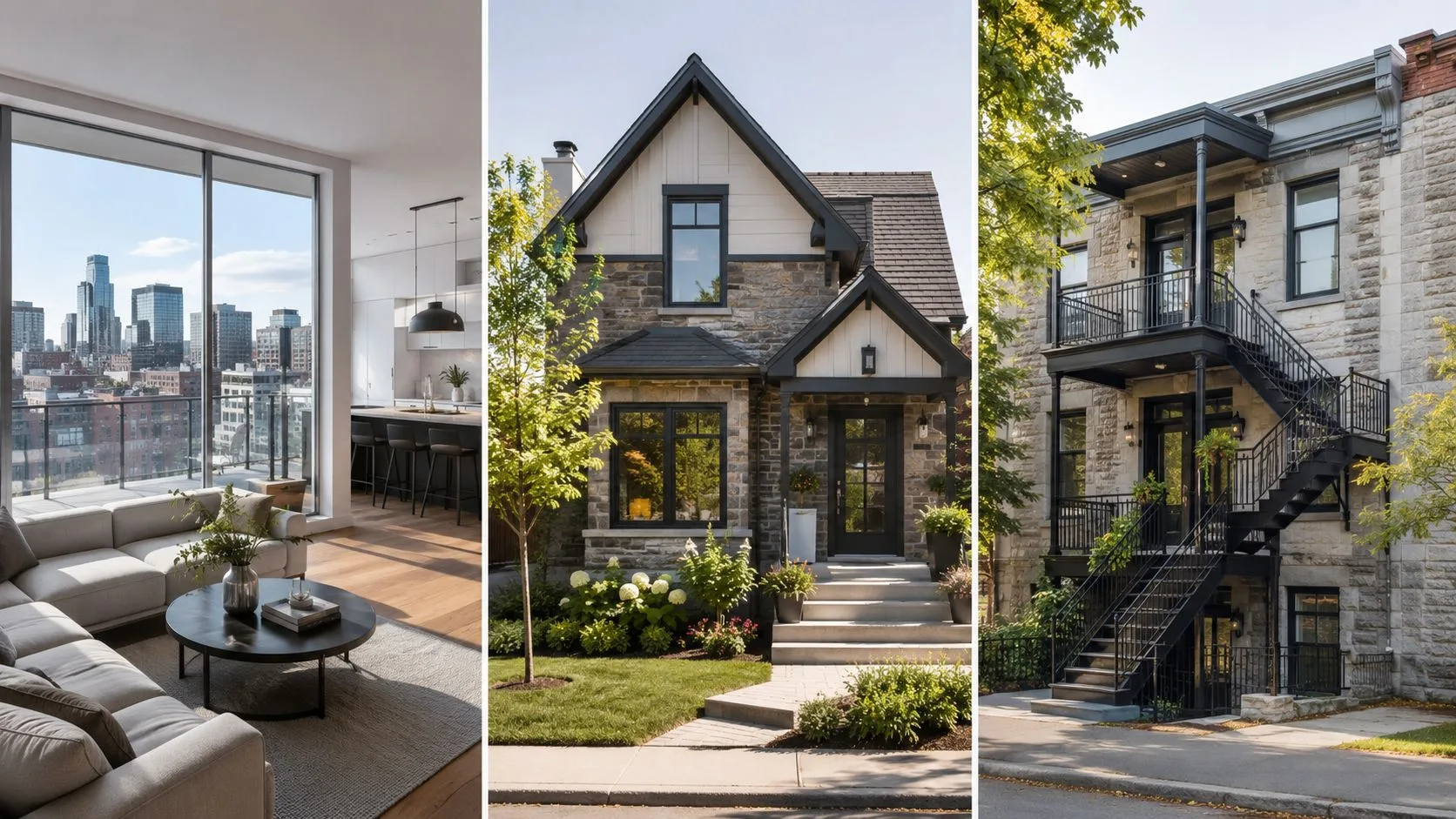
Montreal's market looks very different once property type is separated. A single-family home median price of $645,000 with 3.2% year-over-year growth in May 2026 signals a market that still rewards family buyers who need land, privacy, and a more stable inventory profile (WOWA). A condominium median of $430,000 with only 0.6% year-over-year growth points to a segment that is still active, but more sensitive to building quality, fees, and competition from other similar units. A plex median of $875,000 with 6.1% year-over-year growth shows the strongest appreciation among the three, which fits a market where income-producing assets remain scarce and attractive.
Why the gap matters
Condos often move on comparison, not emotion. A buyer looking in Griffintown or Ville-Marie is usually balancing location, layout, fees, and whether a newer building justifies a higher sticker price. That is where new-build pricing pressure matters, because a resale condo near a fresh delivery pipeline has to compete with features buyers can see and compare immediately.
Single-family homes behave differently. In the West Island, and in other family-oriented pockets, buyers are often paying for more than a structure. They are buying school catchments, yard space, and the ability to avoid renovation risk. That keeps the segment resilient even when overall market conditions soften.
Plexes are the most specialised of the three. A triplex or fourplex is not just a place to live, it is also an asset with income sensitivity, and that helps explain why they can outpace the broader market when rental demand is strong. Sellers in the Plateau or similar neighbourhoods should not price plexes off condo averages. The comp set has to reflect income, maintenance, tenant profile, and long-term ownership math.
For buyers, the practical lesson is simple. A downtown loft, a detached home in Pointe-Claire, and a plex near the Plateau are not substitutes. They are different markets with different rules, and the negotiation strategy should match the segment, not the citywide average.
Neighborhood Snapshots Across Greater Montreal
Downtown Montreal and Ville-Marie tend to attract professionals, downsizers, and investors who care about access, transit, and building quality. In those areas, pricing often turns on condo features, monthly fees, and how well the building competes with nearby newer inventory. That is where a careful read of recent sales matters more than broad citywide pricing.
Where each submarket tends to fit
Griffintown and the Old Port still lean heavily into condominium living, with a buyer base that includes first-time purchasers, investors, and people relocating from outside the city centre. New-construction supply affects those pockets more than it does older neighbourhoods, so a broker has to compare a listing against current pipeline pressure, not just last month's solds. A current view of Griffintown condos for sale is useful because it shows how direct the competition can be between similar units.
The Plateau remains a different kind of conversation. Triplexes and duplexes there often carry heritage character, tenant history, and long-term value considerations that make them attractive to owners who want both lifestyle and income potential. Buyers there usually need sharper due diligence because the right property can be excellent, but the wrong one can become a management burden fast.
The West Island is still the family-home conversation. Buyers there usually focus on detached houses, lot size, commuting access, and school-oriented planning. Sellers in that area need to present homes cleanly and price them against the immediate family-home pool, not against urban condos that happen to have sold at similar dollar values.
Laval, the South Shore, and the North Shore each serve buyers looking for more space or different budget dynamics, but the inventory mix varies enough that local comparisons matter. Some buyers move there for value, others for commute trade-offs, and others because they want a specific style of home that is harder to find on the island. The right neighbourhood is usually the one that fits the daily routine first, then the financing.
A relocating family does not need the “best” neighbourhood in the abstract. It needs the one whose property mix, commute, and resale path all line up with the household's next five years.
Buyer and Seller Strategies for 2026
The 2026 market rewards precision. Buyers still face competition in the best pockets, but the rise in listings and the softer transaction pace mean there is more room to compare than there was at the height of the seller's market. That is especially true in condos, where a buyer should look closely at fees, reserve fund health, building age, and comparables before assuming a lower asking price means better value.

What buyers should do differently
A buyer in the condo market should be comfortable taking a second look when fees or building condition do not align with the asking price. In single-family segments, speed still matters, but a cleaner strategy is often better than a rushed offer. In plexes, the numbers have to work on both the property and the income side, because a strong headline price can still be the wrong purchase if the rent roll and maintenance profile are weak.
Sellers should avoid pricing off the citywide average and instead use segment comps that match the property. A Plateau plex should not be benchmarked against an average condo result, and a West Island detached house should not be tested against downtown data. Pre-listing preparation matters more when buyers have more choice, because a home that shows poorly will sit while a better-presented comp gets the attention.
For buyers who want a straightforward condo search process, buy apartment in Montreal is the kind of local search path that helps keep the process focused on actual inventory rather than broad browsing. For sellers, the better question is whether the listing is positioned against the right competition from day one.
Interpreting Forecasts, Closing Costs, and the Tools You Actually Need
Royal LePage's Q4 2025 forecast pointed to a Greater Montreal aggregate home price of $655,082, with a projected 6.5% increase from Q4 2024, while its median forecasts showed $750,780 for single-family detached homes and $507,210 for condominiums (Royal LePage). Those numbers fit the 2026 picture well enough to confirm that prices stayed firm even as the market became less frantic.
CMHC's Housing Market Outlook 2026 says pressure should ease in 2026 because demand growth is moderating, driven in part by slower population growth, while residential sales and prices are still expected to rise, just less sharply than in 2025 (CMHC). That is a sensible framing for Montreal right now, a market that is still supported, but less likely to reward sloppy timing or guesswork.
Closing costs also matter more than many buyers assume. Notary fees, welcome tax, and Quebec-specific transfer obligations can change the actual cost of a move, especially for first-time buyers and clients relocating from outside the province. A practical calculator such as understand property closing expenses is useful before making an offer, and the same applies to the Quebec welcome tax calculator when buyers need a clearer view of transfer costs.
A solid Montreal transaction uses the right tools in the right order, current MLS and Centris comps, neighbourhood-level sold data, and closing-cost estimates that reflect Quebec rules. For anyone trying to decide whether to buy, sell, or wait, the key question is not just where the market stands. It is what that market means for a specific address, a specific budget, and a specific timeline.
Alp Perez works with buyers and sellers across Greater Montreal, including condos, plexes, and family homes in the core, the West Island, and the South and North Shores. If you want a grounded read on your next move, visit Alp Perez and reach out for a direct conversation about pricing, neighbourhood fit, and the cost of getting the transaction done properly.
About The Author

Related Posts

Certificate of Location in Quebec: A Montreal Buyer’s Guide
You've probably seen the moment already. The offer is accepted, the moving…
Condo Buying Checklist – Full Guide
Condo Buying Checklist Buying a condo rather than a house is very popular…